How do you check an HVAC system during a showing?
Find the data plate, run the system for a few minutes if the weather allows it, and look at the unit itself for rust, dents or water stains. That combination tells you more in five minutes than most buyers ever bother to check.
The outdoor condenser sits outside, usually beside the house. The data plate with the model and serial number is stamped on its side. For the furnace, open the front cabinet door and the plate is inside. Photograph both. You'll need the numbers in a minute, and you don't want to be standing in someone's side yard trying to type a 12-digit serial number into your phone from memory.
Turn the system on if you can. Set the thermostat a few degrees past the current temperature and listen. A healthy system starts smoothly and runs quietly. Hissing, rattling, banging or grinding on startup all point at something specific, a loose part, a failing motor bearing, or refrigerant escaping, and none of those are normal operating sounds.
How do you find the age of a furnace or air conditioner?
Decode the serial number on the data plate. Most brands, including Carrier, Bryant and Payne, encode the manufacture week and year directly in the first four digits. Trane uses a different layout. Get the brand wrong and the decode is wrong too.
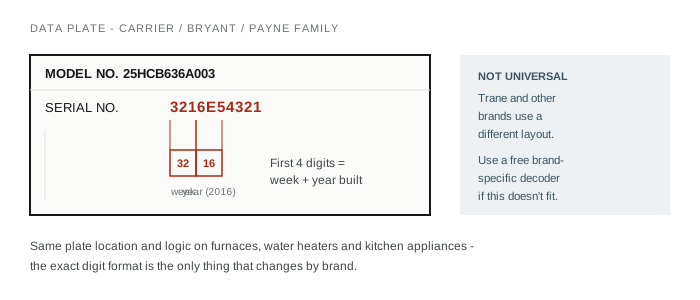
Rather than memorizing every manufacturer's format, use a free decoder. Building-center.org and hvacchecker.com both cover most major brands from the serial number alone, and the AHRI directory (ahridirectory.org) is the industry's own lookup when a brand-specific tool comes up empty.
What are the warning signs of a failing HVAC system?
Constant running or short-cycling, unusual noises on startup, a musty smell from the vents, and a missing maintenance history are the five things worth checking. Any one of them is a reason to ask more questions. Two or more together are a reason to budget for replacement, not repair.
| What you notice | What it means | Typical cost | Verdict |
|---|---|---|---|
| Unit runs constantly, or short-cycles on and off | Undersized system, failing compressor, or refrigerant leak | $400 - $2,500 to diagnose and fix | price |
| Hissing, rattling or banging when it starts | Loose parts, failing motor bearing, or refrigerant escaping | $150 - $1,000 | price |
| Musty smell from the vents | Mold or moisture in the ductwork or evaporator coil | Duct cleaning $300+, mold remediation varies | price |
| No maintenance or service records offered | Can’t confirm the system was serviced; deferred maintenance shortens remaining life | N/A - raises risk on every other line | note |
| Unit is 15+ years old (furnace) or 12+ years old (AC) | Inside or past the typical replacement window | $7,000 - $20,000 full replacement | price |
| Repair estimate approaches half the cost of a new system | Replacement is the better financial call, not another repair | Compare $2,500+ repair vs. $7,000+ replace | walk |
Ask the seller directly for maintenance and repair records, including annual tune-ups and filter changes. A system with a documented service history is a genuinely different asset than an identical system with no paperwork, even if both look the same from the outside. No records doesn't mean no maintenance happened. It means you can't verify it did, and that uncertainty belongs in your offer.
What does HVAC replacement cost?
A furnace alone runs $3,500 to $7,500 installed. An air conditioner alone runs $3,000 to $15,000. Replacing both together, standard efficiency, runs $7,000 to $14,000, and high-efficiency systems push that to $10,000 to $20,000.
Refrigerant is worth its own line item now. R-410A, the refrigerant in most residential systems installed over the last two decades, climbed 40 to 60% in price after a January 2025 production phase-down. A refrigerant leak repair that would have been routine a few years ago is meaningfully more expensive today, which tips the math toward replacement faster on an older system than it used to.
When a repair estimate approaches half the cost of a new system, replacement is the better financial decision almost every time, because you're paying major-repair money for a system that's still aging out from under you. A $2,000 compressor repair on a 16-year-old unit is a worse deal than it looks.
What can a walkthrough not tell you about an HVAC system?
A walkthrough can't measure refrigerant charge, inspect the inside of the ductwork, or confirm the system is sized correctly for the house. Those require a technician with gauges and, for ductwork, a camera.
An oversized or undersized system can run for years without an obvious symptom beyond higher bills and uneven temperatures room to room, which is easy to miss on a single showing. If the age, the noises, or the lack of records leave real doubt, a specialized HVAC inspection during the option period is worth booking. It costs far less than guessing wrong on a $7,000 to $20,000 system.
Questions buyers ask
- How long does an HVAC system last?
- A furnace typically lasts 15 to 20 years and a central air conditioner 12 to 17 years. The two are often replaced together even though the furnace usually has more life left, since matching a new AC to an old furnace can void warranties.
- Should you run the air conditioner during a showing?
- Yes, if the weather allows it. Run it for several minutes and listen for unusual noises, check that it actually cools, and see how long it takes to reach a comfortable temperature. A slow, weak response is worth asking about even if the system technically works.
- Does an old furnace justify a lower offer?
- It supports one. A furnace past 15 years is inside its expected replacement window, and pairing that fact with a contractor estimate is stronger than citing age alone when you negotiate.
- What is the difference between a furnace and a heat pump?
- A furnace burns gas or uses electric resistance to generate heat. A heat pump moves heat from outside air instead of generating it, which makes it both a heater and an air conditioner in one unit, common in milder climates.
Related checks
Cost and lifespan figures: Angi, Sears Home Services, CBS News and homecostcalcs.com 2026 HVAC pricing data; Carrier, Trane, Bryant and Filterbuy manufacturer lifespan guides; HomeGuide, Breaking AC News and Classic Heat and Air on repair costs, including the R-410A refrigerant price increase following the January 2025 production phase-down. Serial number decoding via building-center.org, hvacbase.org and the AHRI directory. Figures are national averages current as of September 2026.